Links
Overview
The goal was to move beyond static navigation and build a system that continuously supports decision-making during travel. TripGuardian combines route drafting, stop curation, and live journey monitoring into one experience, so users can plan quickly and still stay flexible when conditions change.
Context
Built for Hackathon 2025 - megabrAIns (Deutsche Telekom IT & Telecommunications Slovakia Hackathon 2025) hosted at the University Library of the Technical University of Košice.
Use Case
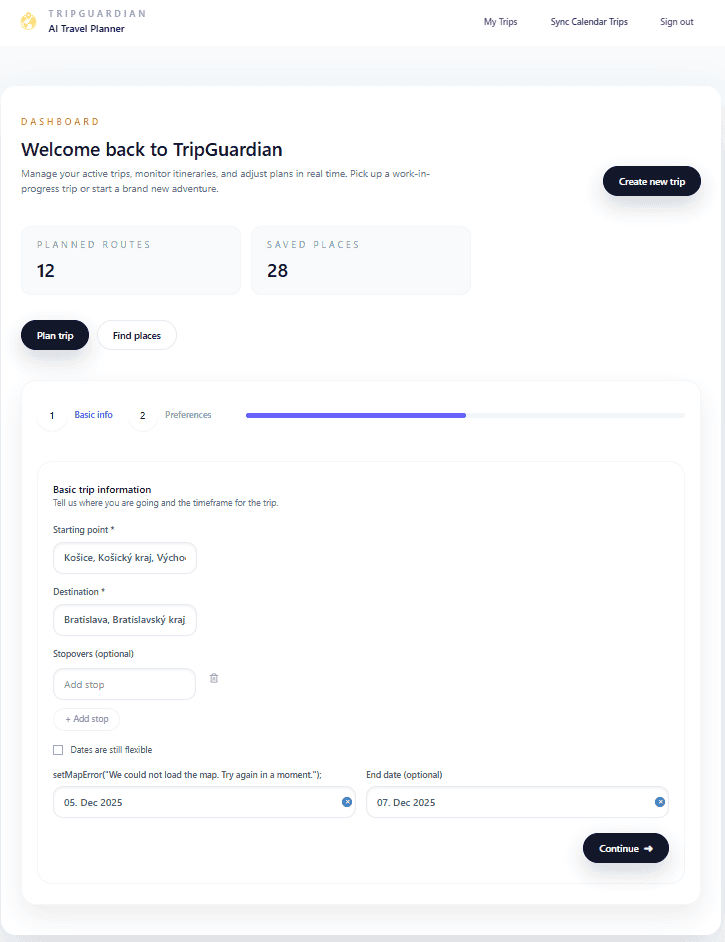
Users can plan a route from A to B and receive curated stops (views, nature, food, culture, quick breaks). When live mode starts, the app tracks the current position and proactively suggests route or stop adjustments to keep the trip efficient and comfortable.
Architecture
Serverless-first architecture with a single backend orchestrator that coordinates autonomous agents. The frontend runs as a PWA and communicates with a lightweight API layer that triggers agent reasoning for planning, calendar evaluation, and live recommendations.
Frontend
React + Vite PWA with an interactive map (Leaflet/Map provider) and a route detail view. Users can review suggested POIs, select final stops, and start live mode for continuous updates and recommendations.
Backend
Backend is organized around agent-driven endpoints. The main entry point is /agent/query which drives the AgentBrain in three modes: planner (route draft + POIs near route), calendar (evaluate calendar events and propose a trip draft), and live (monitor an active trip and return recommendations). Inputs support structured_trip (start, destination, stops, preferences including budget), current_location, active_route_id, delay_minutes, and optional calendar_event / user_profile. A /health endpoint returns a simple status JSON.
Features
Route draft generation with POI suggestions near the route, stop selection and ordering, saved route details, and live mode recommendations based on timing and external conditions. Recommendations are delivered as clear, text-focused actions the user can accept or ignore.
Development
Designed as an MVP with a clear separation between UI flows (planning → route details → live mode) and agent reasoning. The backend can be run locally for fast iteration and testing of agent behavior without AWS infrastructure.
Deployment
During the hackathon, the app was deployed using AWS hosting components (PWA distribution via CDN). The architecture remains compatible with a serverless deployment model for scaling and cost-efficient operation.
AI Processing
TripGuardian uses multiple autonomous agents that coordinate through an orchestration layer. The agents handle route planning, calendar-based trip detection, and live journey reasoning, producing actionable suggestions rather than a single static plan.
Collaboration
Developed by a student team of 5 members during the hackathon timeframe, with a focus on rapid iteration, clear agent responsibilities, and an end-to-end working demo.
Team
Student team of 5